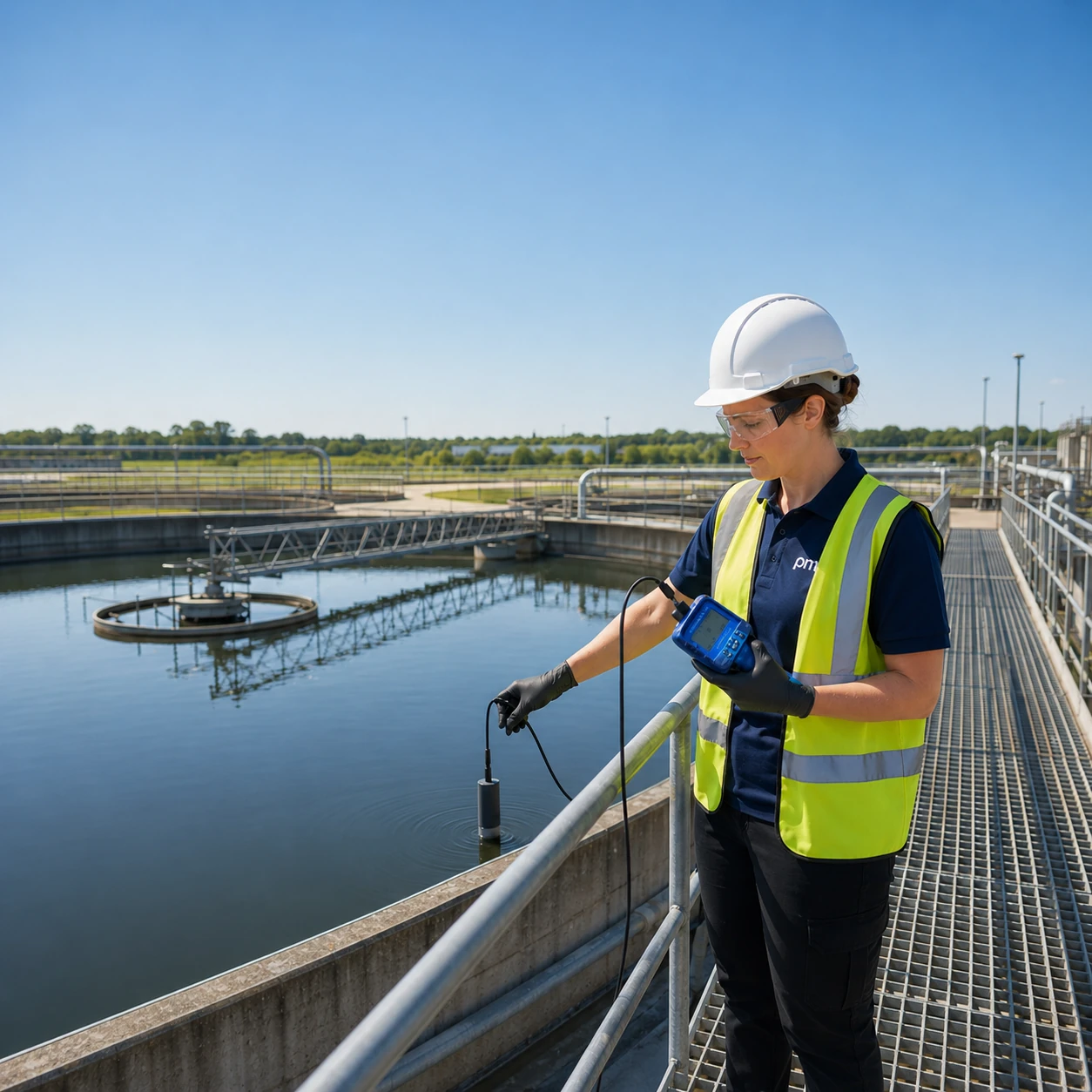
Sludge blanket depth is the position of the interface between settled solids and the clearer liquid above. In secondary clarifiers, settlement tanks and similar processes, monitoring that interface helps operators understand how the solids are behaving and whether the tank is operating within its intended process envelope.
Why measure the sludge blanket?
A changing blanket depth can be a useful prompt for closer investigation. It may reflect changes in solids loading, return activated sludge operation, sludge withdrawal, settlement characteristics or hydraulic conditions. The result does not diagnose the cause on its own, but it provides a practical observation that can be compared with a site’s normal operating pattern.
How portable sludge blanket measurement works
Portable sludge blanket meters use a probe lowered through the water column. On the Royce Aqua 22, a hydrostatic level sensor provides interface depth measurement. The meter is lowered steadily, the depth reading is observed at the identified interface, and the result is recorded against the tank and time. A consistent technique matters: use the same access point where practicable, lower the probe at a controlled rate and record the operating context.
A practical field method
1. Work safely
Follow the site’s safe system of work around open tanks, access points and lifting. Check the cable, probe and instrument before use.
2. Record the context
Note the tank, time, weather or flow conditions where relevant, and any changes in return sludge, withdrawal or process operation.
3. Lower the probe consistently
Lower the sensor through the liquid column at a controlled rate. Avoid using a hurried technique that makes it difficult to identify the same interface consistently.
4. Record and compare
Write down the depth, instrument used and any observation about the tank. Compare it with the site’s own normal range and trend, not a universal number.
5. Use the result to guide the next check
Where the reading is unexpected, bring in related evidence such as MLSS, settlement tests, supernatant clarity, flow and sludge withdrawal information.
The Royce Aqua 22 portable meter
The Royce Aqua 22 combines sludge blanket depth measurement with MLSS/TSS measurement in one portable system. Its TSS range is 0–20,000 mg/L and its stated depth range is 0–10 m. The standard polyurethane cable is 10 m, with other lengths available to order.
The handheld instrument is rated IP65 and the sensor IP68. It uses smart serialised sensors that hold calibration data internally, allowing sensor interchange without recalibrating the handheld. Up to nine date- and time-stamped readings can be saved, which is useful for routine tank-side checks. Confirm the supplied sensor, cable and current configuration with PMA for your application.
Use a trend, not a single number
A portable meter is most useful when it is part of a consistent site routine. One measurement may indicate that something deserves attention; a series of readings taken in the same way can reveal movement over time. Combine blanket depth with settlement and solids information to support a more complete process conversation. The S3A suspended solids settlement analyser provides a related method for repeatable MLSS and SVI testing. Explore PMA’s wider instrumentation range and the PMA News introduction to portable water quality analysers for broader application information.
Frequently asked questions
What does sludge blanket depth measure?
It measures the position of the interface between settled sludge and the clearer liquid above it. The result is normally recorded as a depth from a defined reference point.
Is there one correct sludge blanket depth for every clarifier?
No. The useful operating range depends on tank design, process conditions, sludge loading and site practice. Compare readings with the site’s normal trend and operating limits rather than applying a universal value.
How can I make sludge blanket readings more repeatable?
Use the same safe access point, lower the probe at a controlled rate, record the tank and time, and keep the measurement technique consistent between operators.
Can the Royce Aqua 22 also measure MLSS?
Yes. The Royce Aqua 22 combines sludge blanket depth with MLSS/TSS measurement. Its stated TSS range is 0–20,000 mg/L and its stated depth range is 0–10 m.
When would the S3A be useful alongside a sludge blanket meter?
The S3A supports repeatable MLSS, SVI, settled sludge level and supernatant clarity testing from a sample. Those results can add settling-behaviour context to tank-side sludge blanket trends.
Discuss your application
See the Royce Aqua 22 product details, or contact PMA to discuss your tank-side measurement task.