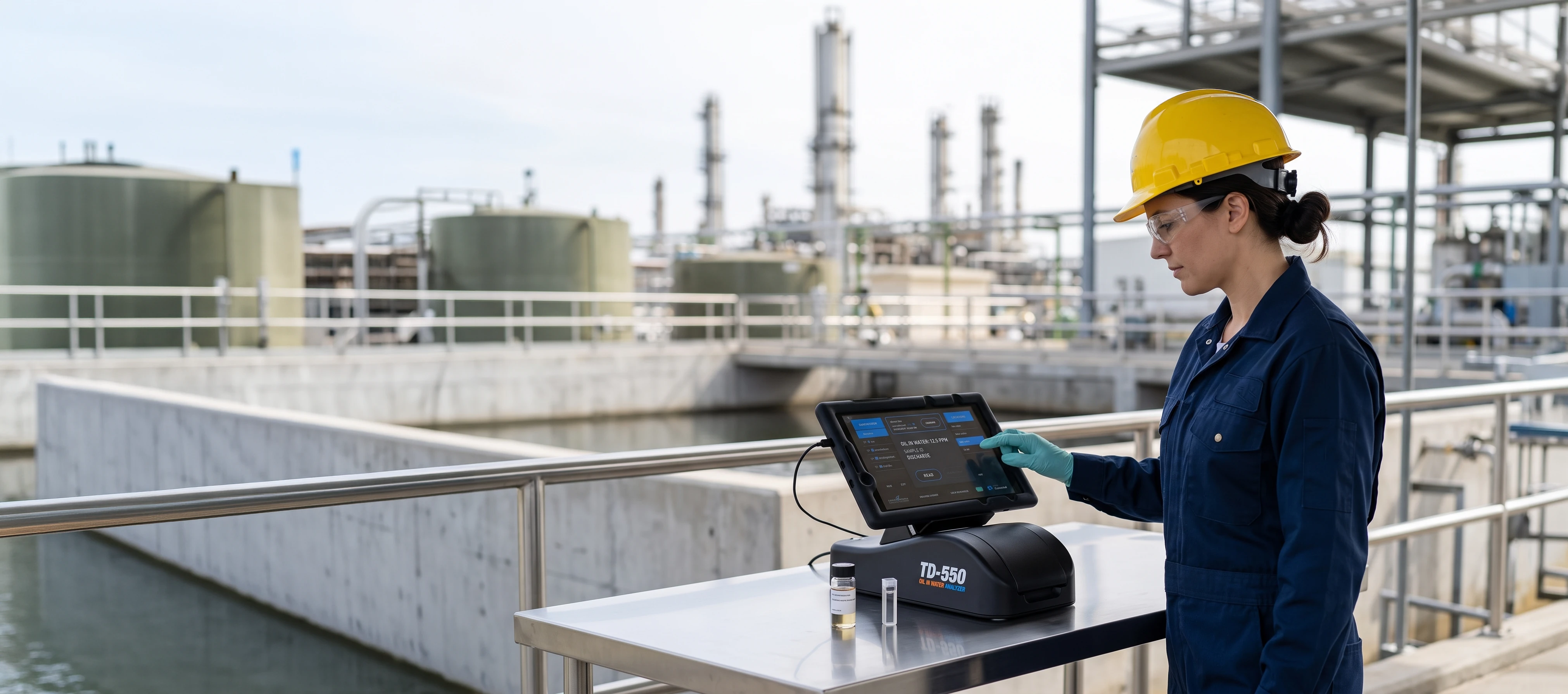
The TD-550 and TD-560 are both portable fluorometers for measuring hydrocarbons in water. They share the same practical strengths: a full-colour touchscreen, data logging, selectable calibrations and rapid field measurement. The choice is primarily about the types of hydrocarbon you need to detect.
The short answer
Choose the TD-550 when the application centres on crude oil, diesel, lubrication oils or fuel oils. Choose the TD-560 where the site also needs sensitivity to lighter hydrocarbons and aromatic compounds such as BTEX, gasoline, jet fuel, kerosene, styrene or phenol. The TD-560 adds a second optical channel, giving it a wider target range.
TD-550: focused on heavier oils
The TD-550 uses fluorescence to detect aromatic compounds within the target hydrocarbon. It is particularly suited to crude and other heavy oils, with measurement suitability determined by the target oil, concentration range and agreed method. It supports direct and raw calibration, along with results in ppm, ppb, mg/L, µg/L or raw units.
TD-560: wider hydrocarbon coverage
The TD-560 retains the heavier-oil capability of the TD-550 and adds a DUV optical channel alongside the NUV channel. This broadens practical coverage to lighter hydrocarbons and compounds including gas condensates, BTEX, gasoline, transformer oils, styrene, phenol, jet fuel, kerosene, heat-transfer fluids and hydraulic oils.
The questions to ask before choosing
- What is the target oil or hydrocarbon? A realistic answer is more useful than selecting on a generic “oil in water” label.
- Will the site ever need to investigate lighter hydrocarbons, condensates or aromatic compounds?
- What concentration range matters, and what action will the result trigger?
- Will the measurement use solvent extraction or a validated no-solvent method?
- Does the method need correlation with a laboratory or regulatory procedure?
Calibration and correlation matter
Fluorescence response depends on the target hydrocarbon. A result is only as meaningful as the calibration and method behind it. Both instruments support multiple calibrations and site locations, helping teams keep field data organised. Where a result needs to be compared with laboratory data or a permit condition, agree the sampling, extraction and correlation approach in advance. A comparison with laboratory results requires an agreed application-specific study; portable fluorescence should not be presented as an automatic replacement for a prescribed method.
Practical features shared by both models
Both models support portable field measurement and recorded results. Confirm the required data export, battery and analysis-time details against the current specification and selected method. These features are useful where a process team needs a quick field answer with a traceable record rather than a subjective visual assessment.
Make the decision around the application, not the model number
If the application is clearly heavy oil, the TD-550 is the focused choice. If the scope is mixed, uncertain, or includes light hydrocarbons, the extra channel in the TD-560 can prevent a capability gap later. PMA can help define the target analyte, calibration approach and sample method before a purchase decision is made. For a practical method example, see the PMA News guide to solvent-free oil-in-water extraction.
Frequently asked questions
What is the main difference between the TD-550 and TD-560?
The TD-550 is focused on heavier oils using its NUV optical channel. The TD-560 adds a DUV channel, extending practical coverage to lighter hydrocarbons and aromatic compounds such as BTEX, gasoline and jet fuel.
Can both instruments measure results in ppm and ppb?
Yes. Both models support results in ppm, ppb, mg/L, µg/L and raw units, provided the selected calibration and method are appropriate for the target hydrocarbon.
Does fluorescence respond equally to every oil?
No. Fluorescence response depends on the aromatic content and characteristics of the target hydrocarbon. Calibration with a representative oil and an agreed sampling method is essential for meaningful results.
Can a TD-550 or TD-560 automatically replace a laboratory method?
No. The portable result can support rapid field decisions and method correlation, but laboratory or regulatory equivalence must be established for the specific application rather than assumed.
Discuss your application
Explore our portable oil-in-water analyser range, then contact PMA with your target hydrocarbon and application to discuss the method.